

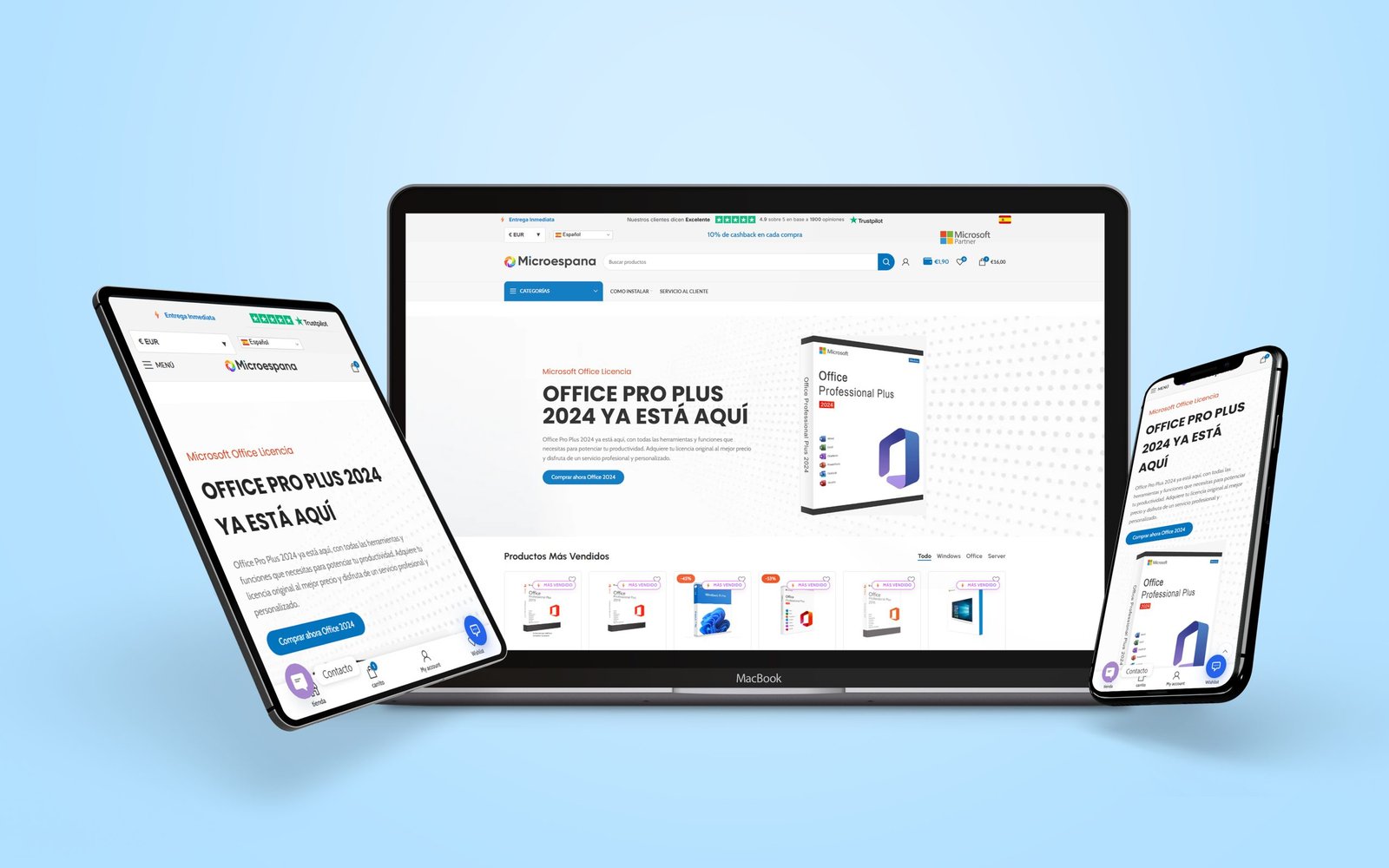

Project Overview
This redesign project involved rebuilding a high-volume WooCommerce store selling Microsoft software licenses — Windows, Office, SQL Server, Visual Studio, and related volume licensing packages — across multiple currencies for a European customer base. The store needed to function reliably at significant transaction volume, with instant digital delivery, a working loyalty mechanism, and infrastructure capable of supporting heavy daily traffic without downtime.
Business Goals
The client’s brief covered an unusually broad scope for a single engagement: a theme migration to WoodMart, a full WooCommerce rebuild, custom PHP functions for store-specific logic, CRM integration to manage customer data and post-sale communication, SMTP configuration for reliable transactional email delivery, payment gateway setup, checkout page bug fixes, site-wide speed optimization, an AI chatbot for product guidance and order inquiries, Trustpilot integration for review credibility, a modern customer dashboard, a credit-earning rewards system on every purchase, ACF-based custom post types for manuals and ISO file downloads, and a full security hardening pass including a web application firewall and VPS server configuration. Each of these was treated as a distinct deliverable rather than a bundled afterthought, given how directly checkout reliability and site security affect a digital goods business processing live payments daily.
Website Strategy
Given the number of moving technical pieces, the project was sequenced deliberately: foundational infrastructure first (server configuration, security, SMTP), then the storefront rebuild (WoodMart theme, Elementor, WooCommerce structure), then customer-facing features (chatbot, dashboard, rewards system), and finally optimization and bug resolution as a closing pass. This order mattered because layering a loyalty system or chatbot onto an unstable checkout flow would have compounded existing issues rather than resolving them.
Design & Development Process
The WoodMart theme was selected for its native WooCommerce styling and the flexibility it offers for a large product catalog organized into multiple categories — Windows, Microsoft Office, Microsoft Project, Visio, Windows Servers, SQL Servers, Visual Studio, volume licensing, and bundled license packages. Elementor was used to build the homepage and key landing sections, including the hero banner promoting current product launches, the best-seller carousel filtered by category, and the trust-signal strip displaying the Trustpilot rating directly in the header.
A modern customer dashboard was built to replace the store’s default account area, giving customers visibility into their order history, license keys, wallet balance, and accumulated purchase credit in one consolidated view, rather than scattering this information across default WooCommerce account tabs.
Technical Implementation
Custom PHP functions were written to handle store-specific logic not covered by WooCommerce or its extensions out of the box, including the purchase-based credit earning system, which calculates and applies a percentage-based cashback balance to each customer’s wallet on every completed order. CRM integration was configured to sync customer and order data automatically, supporting post-sale follow-up and customer service workflows outside the WordPress admin.
ACF was used to create a custom post type structure for product manuals and ISO file downloads, giving each software product its own attachable resource library, independent from the main product description content. This was particularly relevant for a software licensing business, where customers frequently need installation guides or ISO files alongside their purchased license key.
SMTP was configured to ensure reliable delivery of transactional emails — order confirmations, license key delivery, and password resets — which is critical for a digital goods business where the product itself is delivered via email. Payment gateway integration was set up to support the store’s multi-currency checkout (EUR and USD), and an AI chatbot was integrated to help customers identify the right software license for their needs and handle common order inquiries without requiring a support ticket.
User Experience Improvements
The modern dashboard, wallet balance display, and credit-earning system work together to create a visible, ongoing incentive for repeat purchases — directly relevant for a store where customers often return periodically for license renewals or additional products. The Trustpilot integration, displayed prominently near the top of every page, reinforces trust immediately, which matters considerably for a business selling software license keys, a category where buyer skepticism about authenticity is common.
Performance Optimization
Site speed optimization was carried out as a dedicated technical pass, addressing asset loading, image delivery, and theme-level configuration to keep page loads fast despite a large product catalog and the additional scripts introduced by the chatbot, CRM sync, and dashboard features. Given the store’s transaction volume, even small speed gains translate directly into reduced cart abandonment.
Mobile Optimization
The WoodMart and Elementor combination was configured to maintain consistent category navigation, product card layouts, and checkout flow across mobile devices, with particular attention paid to the multi-currency selector and wallet balance display remaining legible and functional on smaller screens.
Conversion Optimization
Checkout page bugs were identified and resolved as part of this engagement, removing friction points that were affecting completed transactions. The credit-earning rewards system, wallet display, and Trustpilot rating all serve a conversion function beyond their individual purposes — together they build the kind of repeat-purchase incentive and trust signal combination that matters for a recurring-customer ecommerce model.
Final Outcome
The completed redesign gives the business a stable, secure, and feature-complete WooCommerce platform capable of handling its transaction volume reliably. The combination of CRM integration, working SMTP delivery, a resolved checkout flow, and hardened server security addressed the operational risk points that matter most for a digital goods store processing live payments continuously.
Conclusion
This WooCommerce redesign project demonstrates the value of treating ecommerce infrastructure, storefront design, and customer engagement features as interconnected systems rather than isolated tasks. From the Sucuri firewall and VPS configuration through to the AI chatbot and credit-earning dashboard, each piece of this build was implemented to support a high-volume software licensing store that depends on speed, security, and trust in equal measure.