


Project Overview
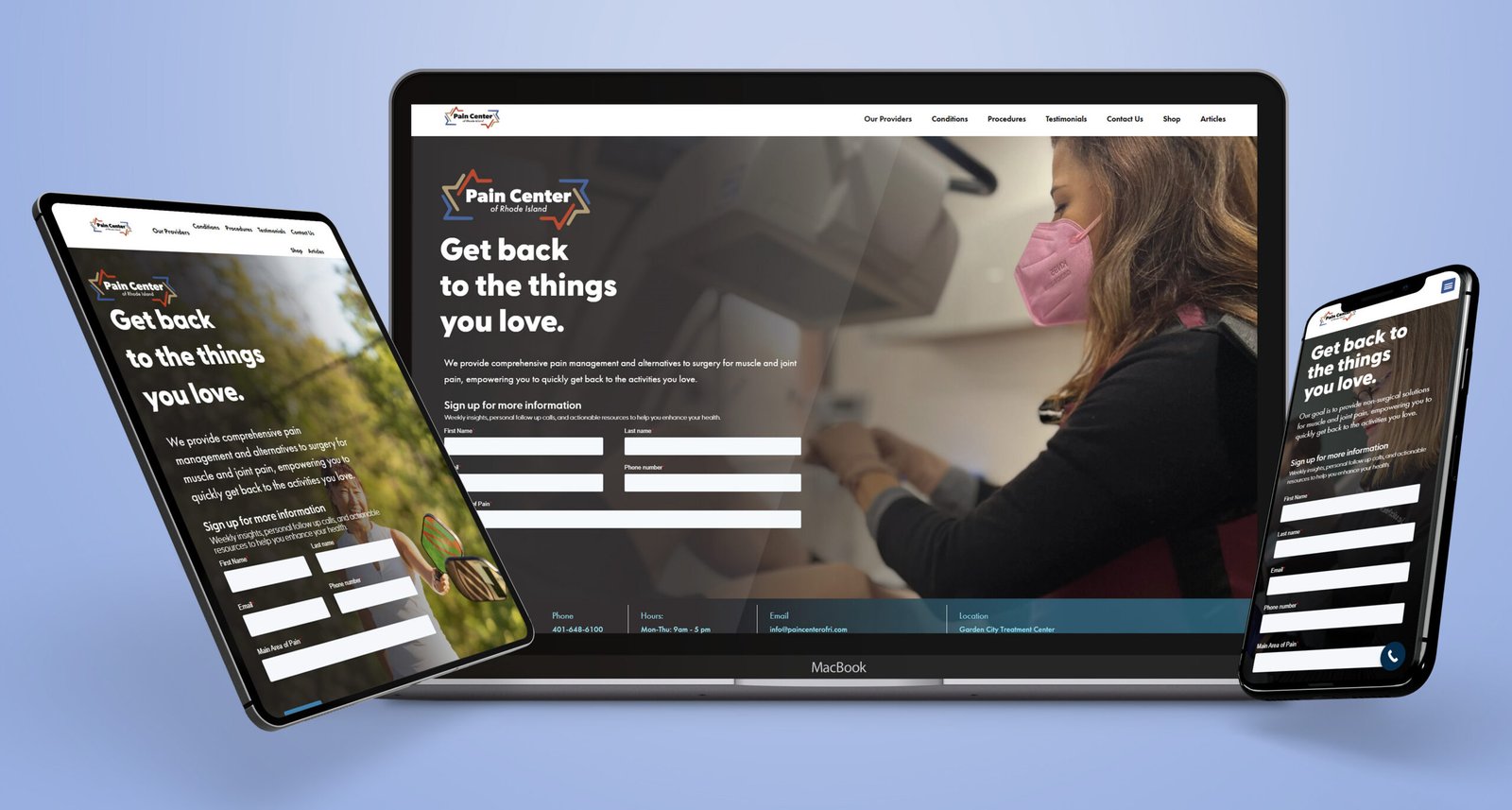
Pain Center of RI is a Rhode Island-based pain management clinic that provides non-surgical treatment options for muscle and joint pain, helping patients get back to the activities they love. Led by Dr. Cherubini, the clinic offers six distinct treatment modalities — Regenexx® regenerative procedures, Cortisone, Shockwave Therapy, EMTT, Laser Therapy, and IV Therapy — across seven body regions. The project was a Figma-to-WordPress conversion that delivered a medically credible patient acquisition platform with HubSpot CRM integration, live Google Reviews from the clinic’s Google My Business profile, and a Google Calendar-based scheduling system embedded directly in the site.
Business Goals
Three objectives shaped the project scope. First, build a conversion-optimized website that earns clinical trust in the first 30 seconds — pain management is a high-consideration category where a patient is weighing the site’s credibility against the fear of making the wrong treatment choice. Second, automate the entire patient inquiry pipeline: every form submission, call request, and scheduled booking needed to route into HubSpot without manual staff intervention. Third, surface the clinic’s authentic Google Reviews directly on the website, removing the friction of a prospective patient navigating away to Google Search to find social proof before deciding to book.
Website Strategy
The site architecture was built around the patient decision journey, not the clinic’s organizational structure. Patients arrive with a specific body part or condition in mind — shoulder, knee, back — so the Conditions section organizes content by body region with dedicated landing pages for each. This means a patient searching “knee pain alternatives to surgery in Rhode Island” lands on a page that immediately confirms the clinic treats their exact situation, before they read a single word about specific procedures.
From there, the Services section presents the six treatment options with individual dedicated pages — creating a dual entry point that serves two distinct patient types: those who know their diagnosis and are evaluating treatments, and those who have been told they need surgery and are actively seeking non-surgical alternatives. A dedicated scheduling path (/meeting/) and a popup-based “Receive a Call” CTA sit in the primary navigation, keeping the conversion action one click away at all times.
Design & Development Process
The Figma design used a clean, approachable medical aesthetic — soft whites with navy and warm accent tones — that deliberately avoids the cold, institutional look common to medical websites. Pain management patients are often anxious and sometimes in crisis; the visual design needed to feel reassuring and human rather than clinical and corporate. Lifestyle imagery of active people reinforced the clinic’s core message: getting back to the things you love.
Two logo variants were built into the Elementor global header — a dark version for the light default state and a white version for the scrolled sticky header state. This scroll-triggered logo swap, handled through Elementor’s header scroll effects and CSS visibility controls, maintains visual accuracy against both background states without JavaScript overhead.
Each of the 13 primary landing pages — 7 condition pages and 6 service pages — was built from a shared Elementor page template with page-specific content, imagery, and metadata. This gave the site structural consistency across a large page set while keeping each page unique for both SEO and user relevance. The Testimonials page was built with named patient stories linked to specific conditions and treatments, providing peer-to-peer credibility that generic testimonial blocks cannot replicate.
Technical Implementation
The Figma-to-WordPress build used Elementor as the page builder with the following technical integrations configured at the WordPress level:
HubSpot CRM Integration: Lead capture forms across the site — the “Receive a Call” Elementor popup overlay, the homepage email nurture signup, and the Regenexx® patient information packet request — were each integrated with HubSpot CRM via HubSpot’s native WordPress plugin. Each form maps to a distinct HubSpot contact list with its own workflow trigger: the call request form initiates the clinic’s callback sequence; the email signup form enrolls contacts in a weekly health insights nurture series; the Regenexx® form triggers the patient info packet delivery. Field mapping was configured per form to capture name, phone, email, and condition interest with correct HubSpot property alignment.
Google Reviews from Google My Business: Verified patient reviews were embedded on the site using the Google Places API, with the clinic’s Google My Business Place ID configured as the data source. This pulls star ratings, reviewer names, and review text directly from Google’s official data, stays within Google’s Terms of Service, and updates automatically as new reviews are posted — requiring no manual content management. Review cards were styled to match the Figma design’s card specification, including star display, reviewer attribution, and text truncation with expand behavior.
Google Calendar — Schedule a Call: The dedicated /meeting/ scheduling page and the “Book Now” navigation CTA connect to a Google Calendar-based scheduling system, allowing patients to self-select a consultation call time directly from the website. The system pre-populates the clinic’s staff schedule with confirmed bookings, eliminating the administrative cost of phone-tag intake coordination and capturing patient intent at its highest-commitment moment.
Additional technical configuration:
- Elementor
additional_custom_breakpointsactivated for three-breakpoint responsive layout (desktop, tablet, mobile) css_print_method-externalfor render-optimized CSS delivery, reducing initial HTML payload- Google Fonts enabled with
font_display-autofor webfont loading management - Facebook Pixel (ID: 1795514271222254) configured for patient remarketing and conversion event tracking
- All media assets served in WebP format, significantly reducing image payload versus JPEG/PNG equivalents
- Google Search Console and Facebook Domain verification configured at WordPress head level
User Experience Improvements
Medical website visitors are not casually browsing — they have a specific pain problem and are evaluating whether this clinic can solve it. The UX was built to answer three implicit questions in sequence: Can you treat my condition? Can I trust you? How do I get started?
The Conditions dropdown in the navigation answers the first question before the visitor reads a paragraph. The Testimonials page answers the second with named patient outcomes tied to specific conditions — Emmanuel Frias (Shoulder, Shockwave), Kerri Cooper (Back and Knee, Stem Cell), Seamus Southern (Rib Cage, EMTT and interferometry) — providing the peer reference that prospective patients actively look for in healthcare decisions. The dual CTAs — “Receive a Call” for patients who want to be contacted, and “Book Now” / “Schedule a Call” for patients ready to self-schedule — answer the third, each serving a different comfort level with self-directed appointment making.
The Financing page in the primary navigation removes the most common objection specific to regenerative medicine: Regenexx® and similar non-surgical treatments are frequently not covered by insurance, and cost uncertainty stops conversions before they start. A dedicated Financing page signals transparency and keeps cost-hesitant patients in the conversion funnel.
Performance Optimization
Image optimization was applied across all uploaded assets — the site’s OG images and treatment photography are served in WebP format, delivering substantially smaller file sizes than JPEG equivalents with no perceptible visual quality loss. Elementor’s external CSS delivery (css_print_method-external) reduces the render-blocking inline style payload on initial page load. Google Fonts were configured with font_display-auto to manage the webfont loading behavior and reduce layout shift from unstyled text rendering.
Elementor Pro’s per-page asset loading was configured to enqueue only the component-specific scripts required on each individual page — condition pages and article pages carry a significantly lighter JavaScript payload than the homepage, which includes the popup and scheduling components.
The Facebook Pixel was configured with standard event tracking for PageView and key conversion events, supporting remarketing campaign performance without adding unnecessary script overhead to non-converting pages.
Mobile Optimization
Pain management patients often search during or immediately after a medical encounter — from a waiting room, a parking lot after a disappointing appointment, or from bed during a sleepless night. The site was built mobile-first with Elementor’s three-breakpoint custom system covering the Figma mobile frames precisely. The phone number (401-648-6100), “Book Now” button, and “Schedule a Call” link remain above the fold on all mobile screen sizes.
The Google Calendar scheduling integration is particularly high-value on mobile, where self-scheduling is frictionless and the alternative — calling an office during business hours — creates drop-off among patients who prefer asynchronous interaction. The popup form was tested for mobile tap accuracy and keyboard behavior to ensure the CTA overlay doesn’t create friction on small screens.
Conversion Optimization
The site runs two parallel conversion paths simultaneously. The active path — “Receive a Call” popup, “Book Now” nav CTA, Google Calendar scheduling — captures patients who are ready to act now, routing them into the HubSpot callback sequence or directly onto the clinic’s calendar. The passive path — condition pages, service pages, articles, Regenexx® info packet request — nurtures patients who need more information before committing, capturing them into the HubSpot email sequence for follow-up over days and weeks.
Live Google Reviews function as a persistent conversion accelerator across both paths: a patient hesitating on the Regenexx® page or the Financing page sees authenticated peer validation at the moment of highest doubt. Reviews update automatically from Google My Business, ensuring the social proof layer stays current without editorial overhead on the clinic’s side.
Final Outcome
Pain Center of RI has a complete, integrated patient acquisition infrastructure: a Figma-accurate Elementor build across 13+ dedicated landing pages, a multi-workflow HubSpot CRM pipeline that segments and follows up every lead type automatically, live Google Reviews that update in real time from the clinic’s verified Google My Business profile, and a Google Calendar scheduling system that converts visitor intent into confirmed appointments without administrative friction. The site is indexed, performance-optimized, and structurally built to perform across both organic search traffic and paid remarketing campaigns driven by the Facebook Pixel.
Conclusion
Medical clinic WordPress website design demands more than design accuracy — it requires a clinical trust architecture built from real patient outcomes, an automated intake pipeline that eliminates manual process gaps, and scheduling infrastructure that removes the barriers between a person in pain and a confirmed appointment. For Pain Center of RI, the Figma-to-Elementor build combined with HubSpot CRM, Google Reviews, and Google Calendar scheduling delivers exactly this: a website that earns trust, captures leads, and books patients around the clock.