

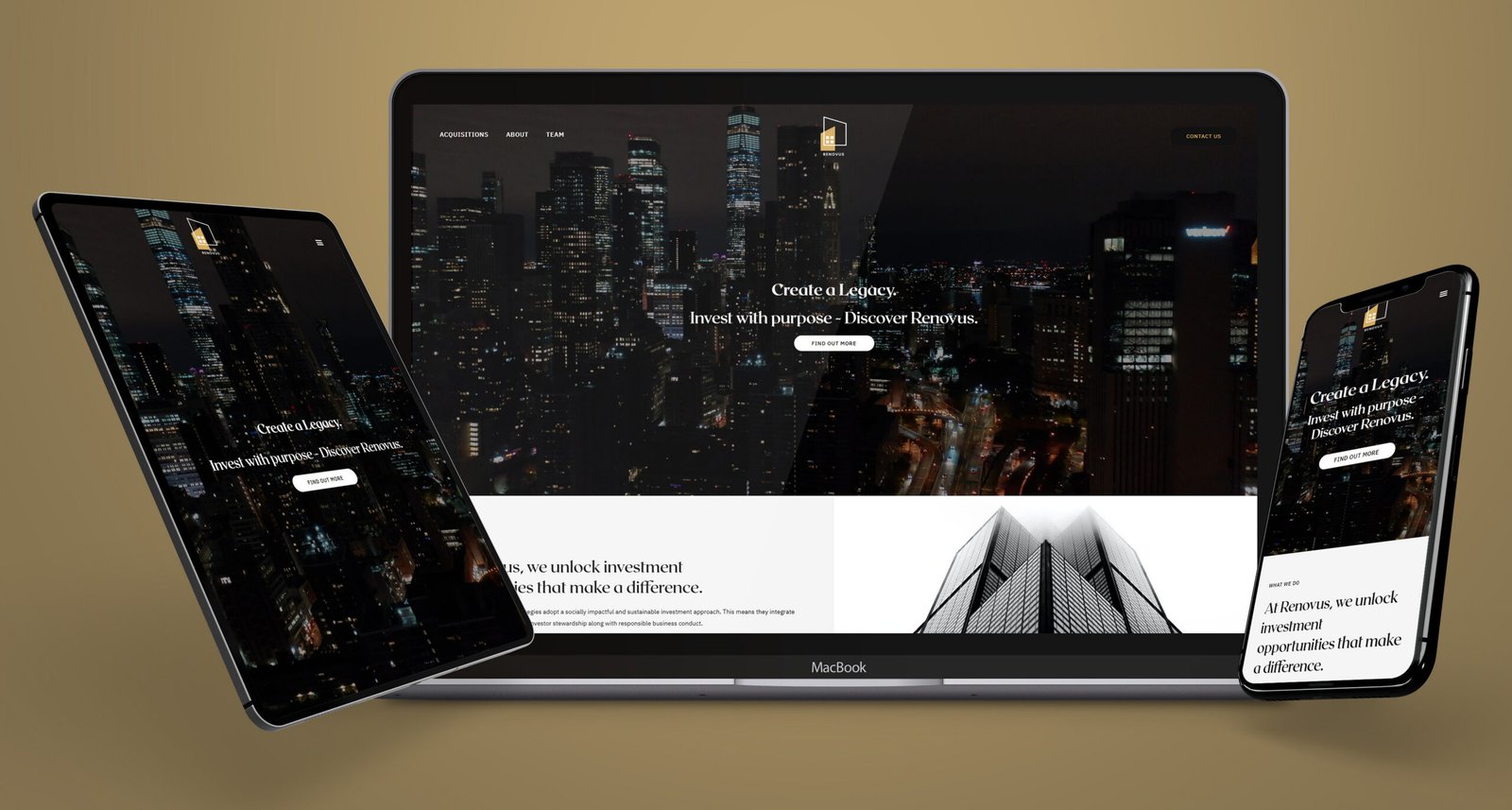

Project Overview
Renovus is a UK real estate firm built around social impact investment — unlocking property opportunities that generate positive returns while contributing directly to the welfare housing market. With over 20 years of collective experience, the team partners with care providers, housing associations, charitable organisations, and government-contract PLCs to provide Specialist Supported Housing (SSH) and Transitional Supported Housing (TSH) across the UK. The project was a Figma-to-HTML conversion: a custom static website built entirely in HTML, CSS, and vanilla JavaScript — no CMS, no page builder, no framework — with a HubSpot CRM-integrated contact form connecting inbound enquiries to the client’s pipeline
Business Goals
Two goals defined the scope. First, establish an investment-grade web presence for a firm where institutional credibility is the primary sales driver. Property investors and housing sector professionals evaluating Renovus form a first impression from the website before any relationship begins — the build had to feel deliberately crafted, not templated. Second, capture inbound enquiries through a structured contact form that routes submissions directly into HubSpot CRM, ensuring no acquisition opportunity or investor inquiry is missed and every lead enters the pipeline with full contact data recorded automatically.
Website Strategy
The architecture was kept intentionally lean: five pages, clean navigation, zero noise. This was a deliberate strategic decision rather than a scope limitation. Renovus’s audience is financially sophisticated — institutional investors and property sector professionals who read websites with high precision. A tight, purposeful five-page site communicates brand confidence. It signals the firm knows exactly what it does and who it serves, without over-explaining either.
The homepage content hierarchy was structured to move the visitor through three questions in sequence: What is this firm? → How does it operate? → Why does it matter? The social impact investing narrative — from the six-fold growth of UK social impact investment between 2011 and 2019, to Renovus’s specific strategy of acquiring properties already under long-term leases with social housing organisations — was positioned as the third stage of this journey, after awareness and credibility had been established. This mirrors the investor due diligence process and leads the visitor naturally toward the Contact CTA.
Design & Development Process
The Figma design used a high-contrast institutional aesthetic: dark backgrounds with crisp white typography for the hero and structural sections, shifting to lighter content areas for body text. This contrast pattern speaks the visual language of the UK property investment and fund management sector — authoritative and considered — while the “Create a Legacy. Invest with Purpose.” positioning thread prevented the design from reading as purely financial or cold.
Every page was hand-coded in HTML and CSS with no utility framework or third-party component library. Typographic scale, section spacing, and layout proportions were extracted from the Figma file and expressed as CSS custom properties at the :root level — creating a consistent, maintainable design token system without build-tool complexity. This meant colour palette changes, spacing adjustments, or typographic updates could be made in one location and propagate across all five pages.
JavaScript was used selectively and scoped tightly. Three functions covered the full interactivity requirement: navigation toggle for the mobile hamburger menu, smooth scroll behaviour for homepage anchor links, and the HubSpot CRM form submission handler. No external JavaScript libraries were loaded — vanilla JS only, keeping page weight genuinely minimal.
Technical Implementation
The delivered site is five standalone HTML files sharing a consistent navigation and footer structure, served as static assets with no server-side processing on any request.
HTML and CSS architecture: Semantic HTML5 elements were used throughout — <nav>, <main>, <section>, <article>, <footer> — providing document structure that is both accessible to screen readers and meaningful to search engine crawlers. CSS custom properties defined the full brand token system (colour, spacing, typography) at :root, with component-level classes built on top. Media queries were written at the breakpoints specified in the Figma responsive frames, with no reliance on a grid framework.
HubSpot CRM integration: The contact form captures Name, Email, Subject, Phone, and Message and submits via a JavaScript fetch() call to HubSpot’s Forms API endpoint. The HubSpot Portal ID and Form GUID are configured as constants in the submission script, with form field names mapped precisely to the corresponding HubSpot contact properties. Two distinct contact addresses — info@renovus.co.uk for general enquiries and acquisitions@renovus.co.uk for property submissions — indicated two separate enquiry intents, each mapped to a dedicated HubSpot pipeline to allow correct lead prioritisation and follow-up routing. Client-side validation fires before the API call to prevent malformed submissions, with inline success and error states displaying on response without a page reload.
JavaScript scoping: Each JS function was written as a standalone module-style block rather than a global script — the navigation toggle is scoped to the header component, the form handler is scoped to the contact page only, and the HubSpot form script tag was placed exclusively on the /contact/ page HTML rather than loaded globally. This prevents HubSpot’s asset bundle from adding load overhead to the other four pages.
No CMS layer: The absence of WordPress, Elementor, or any other CMS is itself a technical decision with measurable performance implications. Static HTML files require no server-side PHP execution, no database query, and no plugin initialisation on each page request. Time-to-first-byte is determined solely by server response speed, not application processing time.
User Experience Improvements
The site serves two distinct visitor types simultaneously without forcing either into the other’s path. Prospective investors follow the About and Team pages — evaluating the firm’s philosophy, experience, and people before making contact. Property professionals (house builders, agents, housing associations presenting acquisition opportunities) go directly to the Acquisitions page. That page functions as a practical briefing document: it lists the property types Renovus acquires (portfolios, blocks of flats, terraced houses, semi-detached, land) and specifies exactly what documentation is required to initiate the acquisition process (floor plans, tenancy schedule, lease, photos, full address).
This specificity on the Acquisitions page is a deliberate UX decision. It respects the professional audience’s time, pre-qualifies the enquiries that arrive through the form, and signals that Renovus operates with process rigour — a trust signal that matters to institutional counterparties.
Performance Optimization
Static HTML delivery is inherently the most performant architecture for a brochure site of this scope. No PHP, no database, no plugin chain — the server responds with a flat file on every page request, giving the site a time-to-first-byte determined by network latency alone rather than application processing time.
CSS was kept in a single external stylesheet referenced from all five page headers, enabling browser caching on return visits. JavaScript was consolidated into a single external script file with page-specific functions conditionally activated based on DOM element presence — the form handler only initialises if the contact form element exists, preventing unnecessary function calls on non-contact pages. Image assets were sized to layout dimensions in the Figma file and uploaded at appropriate resolutions — no CSS-based scaling of oversized originals was used.
Mobile Optimization
The Figma design included explicit mobile breakpoint specifications. CSS media queries were written at those exact breakpoints — the multi-column desktop layout collapses to single-column on mobile, the horizontal navigation condenses to a hamburger menu controlled by the JavaScript toggle, and the hero typography scales to prevent horizontal overflow at small viewport widths.
The hamburger navigation was implemented with ARIA attributes — aria-expanded, aria-controls — on the toggle button to ensure keyboard navigability and screen reader compatibility. Navigation link tap targets were set to a minimum height of 44px via CSS padding, meeting mobile usability standards for touch interaction.
Conversion Optimization
The “Contact Us” CTA sits in the global header, present and accessible on every page without a secondary click. The “Get in Touch” CTA on the Acquisitions page routes property professionals directly to the form at the moment their intent is highest — immediately after they’ve confirmed the firm acquires what they have and understood the documentation required.
The HubSpot CRM integration converts the form from a simple email sender into a lead pipeline entry point. Every submission creates or updates a HubSpot contact record, triggers the appropriate workflow, and enters the correct pipeline — general enquiry or acquisition — with no manual intervention required. The inline success state after submission confirms receipt and manages expectation without navigating the visitor away from the page.
Final Outcome
Renovus has a fast, clean, investment-grade static website that accurately represents the firm’s positioning in UK social impact real estate. The five-page hand-coded HTML/CSS/JS build delivers performance that no CMS-based equivalent at this scope can match, and the HubSpot CRM form integration means every inbound enquiry — from institutional investors or property acquisition partners — enters the pipeline automatically with full contact data captured and correctly routed from submission.
Conclusion
Custom HTML CSS website development for a property investment firm is a brief that rewards precision and restraint. The Renovus project demonstrates what hand-coded development produces when CMS overhead is removed: a faster, leaner, more maintainable site that earns credibility from its first-load performance as much as from its design. Connecting the contact form directly to HubSpot CRM via the Forms API completes the brief — the site captures business, not just visitors.