

Project Overview
Suena Games is a free online gaming platform built to compete in the browser-gaming portal space — a category with significant traffic potential driven by casual players seeking instant-play games without downloads, registrations, or installations. The platform hosts over 5,700 titles organized across 15 genre categories: Puzzle, Arcade, Girls, Hypercasual, Adventure, Racing, Action, Shooting, Clicker, Sports, Boys, Stickman, 3D, Multiplayer, and Soccer. Each game is playable directly in the browser, rated by users on a five-point scale, and tracked for total plays — giving the catalog a live engagement layer that surfaces the most popular titles naturally. With a content library of this scale, the project demanded a custom WordPress theme built specifically for a game catalog architecture, rather than any adaptation of a general-purpose theme or page-builder framework.
Business Goals
The platform’s revenue model is advertising-based, making Google AdSense integration and approval a primary business objective rather than a secondary technical task. A gaming portal that cannot display AdSense ads generates no revenue from its traffic, so the AdSense approval process — which requires demonstrating content quality, policy compliance, clean site structure, and appropriate content categorization — shaped several development and content decisions from the earliest stages of the build. Beyond AdSense, the platform needed a CRM-connected contact infrastructure for developer submissions and user enquiries, a dark and light mode preference toggle for the extended play sessions common to gaming audiences, and a fully responsive layout that performed consistently across desktop, tablet, and mobile — the three device types that collectively represent the full distribution of casual gaming traffic.
Website Strategy
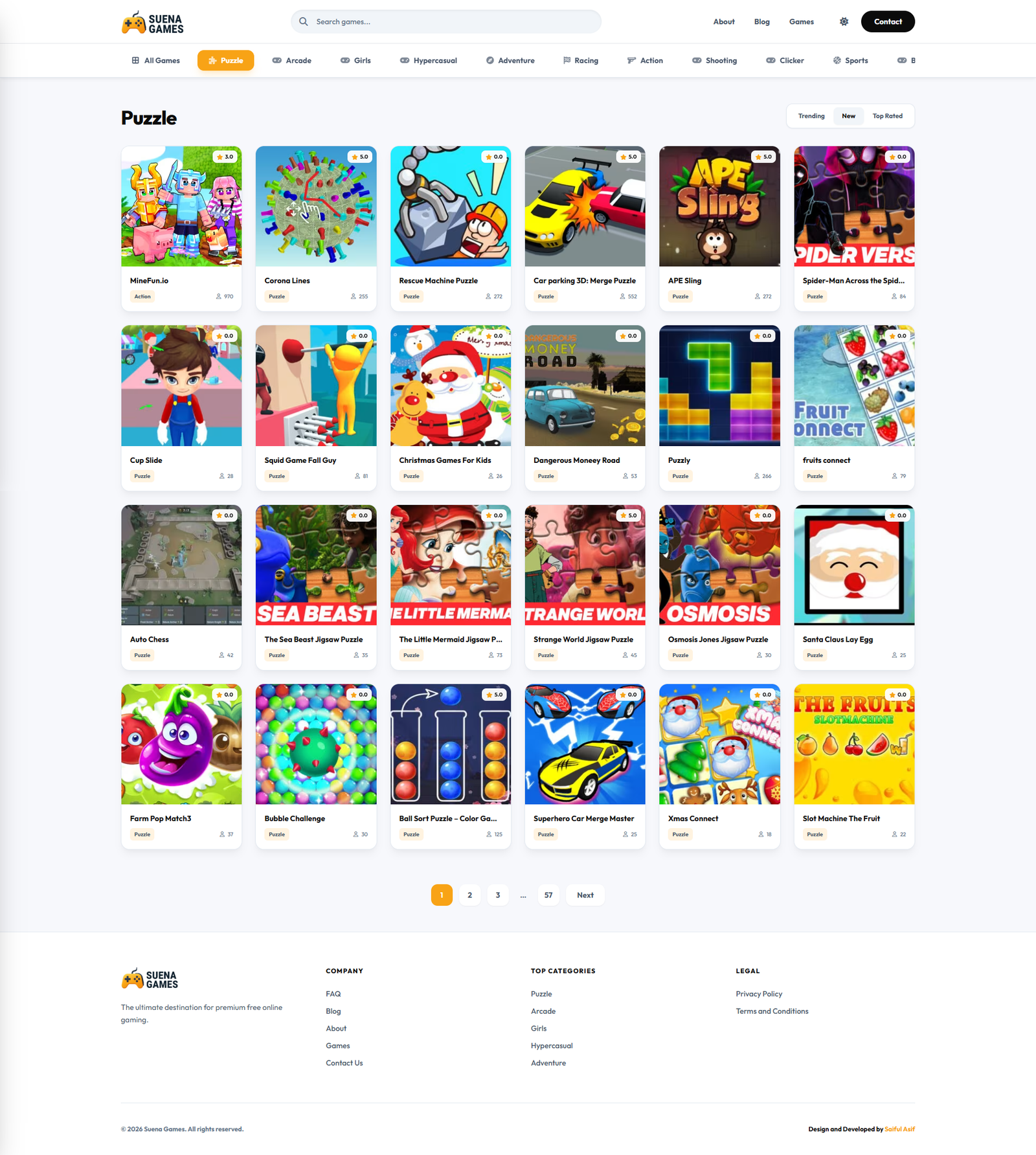
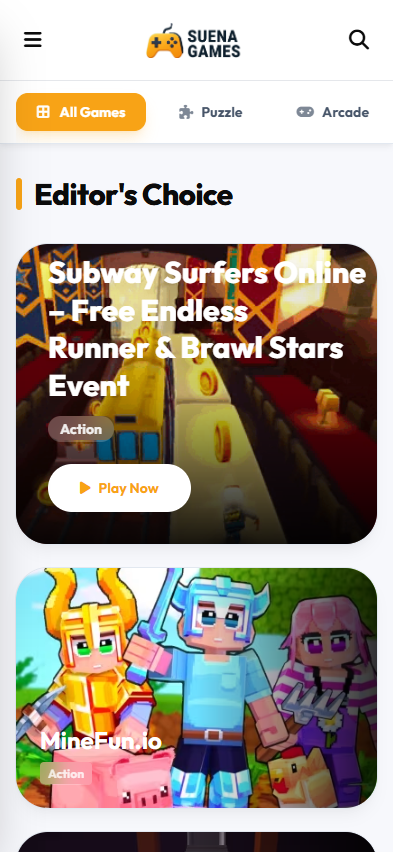
The information architecture was planned around a dual browsing model: visitors who arrive with a specific genre interest, and visitors who want to discover new games without a particular category in mind. The category strip immediately below the navigation header — showing game counts per category — serves the first group, giving them a direct path to their preferred genre with a visible count of available titles. The filterable Trending Now grid on the homepage — toggling between All, Trending, and New — serves the second group, surfacing curated and recently added titles without requiring a genre decision first. The Editor’s Choice section above the grid adds a third discovery layer, featuring hand-selected titles that may not appear at the top of trending lists but represent standout quality within their genre. This three-layer discovery architecture — featured selection, filterable trending grid, category browsing — keeps the homepage useful to both new and returning visitors without reducing it to a single undifferentiated list.
Design & Development Process
A custom WordPress theme was built from scratch rather than adapting an existing theme or building over a heavy page-builder framework. This decision was foundational: a gaming portal with 5,700-plus titles requires a page rendering architecture that can handle hundreds of game post entries per category archive, paginated across 240 pages of catalog, without the performance overhead of a theme designed for standard content sites. The custom theme controls every template directly — the homepage grid, the category archive layout, the single game page, the category filter strip, and the footer category links — giving precise control over markup structure and asset loading at every level.
Elementor was used selectively for the static informational pages — About, Contact, FAQ, Blog — where page-builder flexibility is valuable and the performance considerations that apply to the game archive and homepage do not. This hybrid approach kept the high-traffic, high-page-count game catalog templates lean while giving the supporting content pages the editing flexibility the site’s ongoing content needs require.
The dark and light mode toggle was implemented at the theme level — visible in the header as an “Appearance” switcher — applying a full color variable switch across backgrounds, typography, card surfaces, and icon treatments sitewide when activated. For a gaming portal where extended sessions are the norm rather than a brief visit, dark mode support is a practical usability feature rather than a visual preference, directly reducing eye strain during longer play sessions.
Technical Implementation
A custom game post type was registered with a structured taxonomy covering the 15 game categories and a tag system for game mechanics (2-player, HTML5, keyboard controls, and similar attributes). Each game post carries a custom field set including the game embed code, thumbnail, category assignment, user star rating, and play count — all managed through the WordPress admin without requiring theme or template editing for each new game entry. This data structure allows the catalog to scale to any volume without the post management workflow changing as the library grows.
The user rating system was built as a theme-level feature attached to the game post type, recording individual user ratings and displaying the aggregate as a five-point visual score on each game card and single game page. Play count tracking was implemented to increment on each game load, providing the engagement data used to populate the Trending tab on the homepage without requiring a third-party analytics layer for this specific metric.
Google Tag Manager was integrated at the theme level across all page templates, providing a clean tag management environment for AdSense performance tracking, conversion events, and future analytics additions without requiring direct template modification for each new tracking need. Google AdSense was integrated following the Site Kit connection method — confirmed by the host publisher ID in the site’s meta configuration — and the site was submitted for AdSense review with content, category labeling, and page structure configured to meet AdSense’s gaming portal policy requirements. Approval was achieved, enabling ad placements across the game catalog and game play pages where advertising revenue scales directly with session volume and page depth.
CRM integration was configured to receive and route contact form submissions from the developer query submission page — the channel through which indie game developers submit titles for inclusion in the library — and the general contact page, ensuring every inbound communication is captured and assigned without manual inbox monitoring.
User Experience Improvements
The single game page was built to prioritize the game play area above all else — the game iframe occupies the full available width immediately below the header, with the game title, rating, and play count displayed inline without requiring the user to scroll before the game loads. This matters considerably on mobile, where a gaming portal visitor who has tapped a game card expects to begin playing without navigating through additional content layers. Category tags on each game card allow visitors who discover a game they enjoy to navigate directly to the same genre category for more similar titles, creating a natural browse loop that extends session depth.
Performance Optimization
The custom theme’s direct template control was the primary performance mechanism on this build. By writing game archive and homepage templates without page-builder wrapper markup or default post thumbnail handling, the per-page DOM weight and CSS specificity were kept significantly lower than a page-builder-based equivalent at the same catalog scale. The external CSS print method was configured through Elementor for the informational pages, and Google Fonts were set to font-display: swap across all templates. Game thumbnails across the catalog were served in AVIF format — visible in the homepage game card image URLs — reducing image payload on pages that render 24 game thumbnails simultaneously across the paginated grid.
Mobile Optimization
Responsive design across all device types was treated as a functional requirement for a gaming platform, not a design consideration. The category strip, game grid, and rating display each required independent breakpoint configuration using Elementor’s additional custom breakpoints feature for the informational page sections and direct CSS media queries in the custom theme for the game templates. The dark mode toggle remains accessible on mobile without collapsing into the hamburger menu, keeping the preference control available during play sessions initiated on a phone. Game iframes were configured with a defined aspect ratio and max-width constraint to ensure they render at a playable size across the full range of screen widths rather than scaling to an unusably small viewport on compact phones.
Conversion Optimization
For an advertising-supported gaming platform, session depth and page view count are the direct revenue drivers. The three-layer discovery architecture — Editor’s Choice, Trending grid, category browsing — is designed to extend the average session beyond a single game, serving the next discovery option naturally as the visitor finishes or exits a game. The newsletter signup in the footer captures player emails for ongoing engagement and new game announcements, building a returnable audience rather than depending entirely on search and social acquisition for each session. The developer submission path gives the platform a structured channel for indie games to join the library, supporting catalog growth without manual outreach.
Final Outcome
The completed platform gives Suena Games a custom-built WordPress foundation capable of serving a 5,700-plus game catalog across 15 categories with a responsive, fast-loading, AdSense-approved architecture. The dark and light mode support, the rating and play count system, and the filterable discovery grid collectively give the platform the usability depth that retains casual gaming audiences beyond a single session — which is the metric that actually determines advertising revenue on a free-to-play portal.
Conclusion
This custom WordPress theme development project for Suena Games demonstrates what a purpose-built theme, designed specifically around a game catalog post type and an advertising-revenue model, can achieve at a scale where generic themes and page builders introduce more problems than they solve. From the AdSense approval process through to the dark mode implementation and the custom rating system, every technical decision was made in service of a platform that earns revenue from the depth and quality of its visitor engagement.