Project Overview
Abogados de Accidentes Latinos — Firma Broadway is a California personal injury law firm operating across six offices and serving a predominantly Spanish-speaking Latino client base throughout the state. The firm handles accident cases including automobile collisions, truck accidents, motorcycle crashes, Lyft and Uber incidents, pedestrian knockdowns, slip and falls, dog bites, and construction accidents, operating on a pure contingency model — no fee unless the firm wins. The landing page was built entirely in Spanish to serve accident victims who search in their native language in the immediate aftermath of a collision, positioning the firm’s cultural and linguistic alignment with the Latino community — “Abogados Latinos, Para Latinos” — as a primary differentiator alongside its verified courtroom record, which includes a $34.5 million verdict and multiple settlements in the eight-figure range.
Business Goals
The client needed a high-conversion single-page landing page, not a conventional multi-page website. The business model of a personal injury firm running paid advertising to a Spanish-speaking audience demands a fundamentally different page structure from a standard law firm website: one that captures a lead within seconds of landing, presents the firm’s credibility immediately, removes every possible obstacle between the arriving visitor and a completed form submission or phone call, and loads fast enough on a mobile device that a visitor in distress immediately after an accident does not abandon before the page finishes rendering. CRM integration was a non-negotiable operational requirement — every form submission needed to route directly into the firm’s case management pipeline without manual data entry or risk of missed enquiries.
Website Strategy
The landing page was structured around a single, unwavering conversion goal: get the visitor to call or submit the contact form, measured in seconds from page arrival. Every section of the page contributes to that goal in a specific role — the hero creates urgency and captures the form, the credential strips build instant credibility, the services section addresses objections, the media logos reinforce legitimacy, the verdict grid demonstrates track record, and the office locations section confirms geographic accessibility. No navigation menu was included. No internal links redirect visitors to sub-pages. Every call-to-action on the page points to either the phone number or the hero form anchor, concentrating all exit intent toward the two contact paths rather than dispersing attention across multiple page destinations.
Design & Development Process
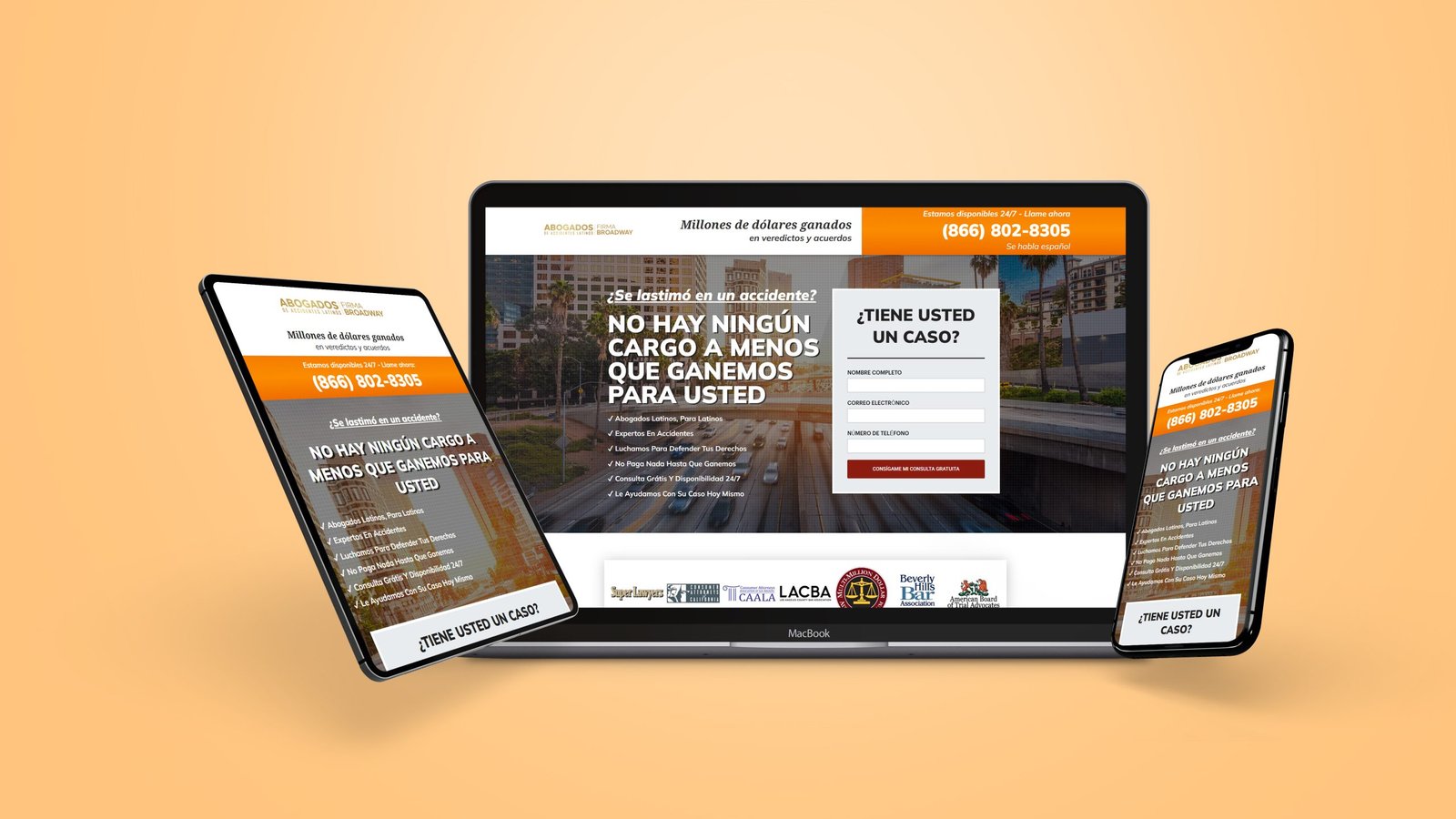
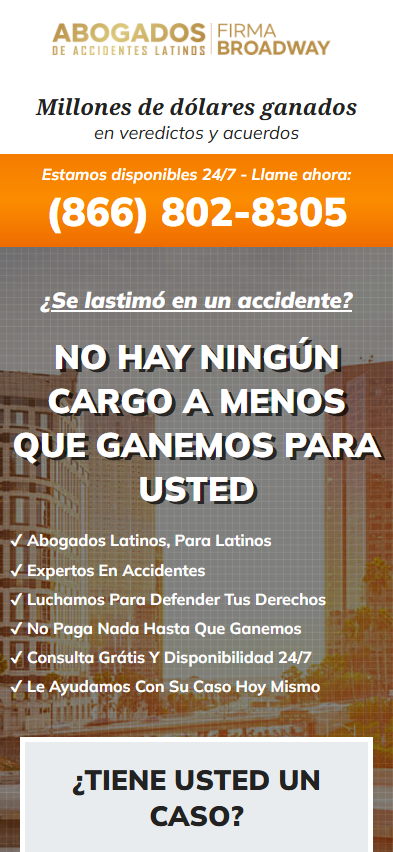
Elementor was used to build the full landing page, with each section designed around a tight conversion-focused content hierarchy. The hero section carries the maximum information load of any section on the page: the firm logo, the headline establishing the track record (“Millions won in verdicts and settlements”), the 24/7 availability statement with the phone number, the Spanish-language service indicator (“Se habla español”), and the contact form with three fields — full name, email, and phone number — and a single high-contrast CTA button (“CONSÍGAME MI CONSULTA GRATUITA”) positioned above the fold on desktop and within one scroll on mobile. This concentration of information in the hero reflects a deliberate design principle: a visitor who has just been in an accident may not scroll further, and the form must be reachable without that assumption being required.
The dual sticky header — a full-width version for desktop and a compact version for mobile — keeps the firm logo and phone number visible at all times as the visitor scrolls through the credential sections and verdict grid, ensuring the call path is never out of view regardless of page position. The verdict grid was built as a multi-column mosaic of settlement figures — $34.5 million, $9 million, $8 million, $6.5 million, and continuing — designed for visual impact rather than detailed reading, communicating financial scale at a glance before the visitor processes individual case descriptions.
Technical Implementation
The build runs on WordPress with Elementor 3.27.6, configured with the external CSS print method to keep styles off the critical render path and Google Fonts with font-display: swap to prevent invisible text during loading. Elementor’s element cache feature was enabled to reduce server-side rendering time on repeat visits, and the additional custom breakpoints feature was used to manage intermediate layout states between the desktop and mobile breakpoints — particularly important for the verdict grid and the bar association credential strip, both of which required mid-size handling to avoid awkward partial-column layouts at tablet widths.
Google Tag Manager was integrated at the page level to manage conversion tracking tags for the contact form submission, phone click, and scroll depth events without requiring direct code modifications to the WordPress template. This gives the firm’s advertising team a clean, manageable tag environment for tracking paid campaign performance against actual lead generation outcomes.
CRM integration was configured to receive form submissions from the hero contact form in real time, routing each submitted lead — name, email, and phone number — into the firm’s case intake pipeline immediately on submission. For a personal injury firm running paid traffic at significant volume, a missed or delayed lead represents a client who may have called another firm in the same window, making real-time CRM delivery a direct revenue consideration rather than an operational convenience.
User Experience Improvements
The services section — structured as eight specific value statements rather than legal service categories — was written and presented to address the actual concerns of an accident victim rather than the formal service taxonomy of a law firm. “Access to the best medical specialists,” “We handle property damage,” “We recover your lost wages,” “We come to your house,” and “Cash advances before your case is resolved” each answer a specific financial or logistical anxiety that a Spanish-speaking accident victim is likely experiencing in the days after a collision, reducing the perceived complexity of engaging a personal injury attorney before any contact is made.
The media presence section — Univision, Telemundo, UniMas, TV Azteca, Telexitos, Fox 26, and KTLA — was positioned mid-page rather than in the footer, giving it the prominence that Spanish-language television credibility carries with the firm’s target audience. For a community where Univision and Telemundo are primary news sources, media recognition from those platforms functions as a more culturally relevant trust signal than bar association membership alone.
Performance Optimization
Speed optimization was treated as a conversion requirement rather than a technical one for this project. Personal injury search traffic arrives predominantly on mobile devices, often from visitors in stressful post-accident situations, and page load time directly correlates with form completion rate. The external CSS print method, element caching, Google Font optimization, and image compression across the credential and media logo sections were implemented collectively rather than selectively, keeping the Time to Interactive metric as low as possible across mobile connections. The contact form was built with a minimal field count — name, email, phone only — which reduces form rendering weight alongside reducing user effort.
Mobile Optimization
Elementor’s additional custom breakpoints were used extensively to tune the verdict grid, credential strips, and services section at intermediate widths. The verdict grid, which presents sixteen settlement figures in a multi-column masonry layout on desktop, was reconfigured to a two-column stack on mobile to maintain visual impact without creating illegibly small text. The dual sticky header system was built specifically to address the different space constraints between desktop and mobile: the full desktop header becomes a compact mobile bar that prioritizes the phone number and logo without the additional contact line text, keeping the call path visible without consuming excessive vertical space on smaller screens.
Conversion Optimization
The page carries four distinct calls-to-action pointing to the hero form anchor, one persistent phone number in the sticky header, and a direct phone link mid-page — six total contact initiation points distributed across the page length. This density is intentional: for a high-urgency legal service where the client’s first call determines which firm handles their case, every section of the page needs a contact path nearby. The contingency fee model — “no charge unless we win” — is stated in the hero headline as the first substantive piece of content after the logo, removing the cost objection before the visitor has formed it. The six office locations in the footer confirm geographic accessibility for visitors across California, addressing the practical concern of whether the firm can actually serve their location.
Final Outcome
The completed landing page gives the firm a fast-loading, conversion-optimized Spanish-language lead generation asset that matches the urgency and cultural specificity of its target audience. The CRM integration ensures every form submission enters the case intake pipeline in real time, the speed optimization keeps the page performant across mobile connections, and the credential and verdict architecture builds the credibility required to convert a first-touch visitor in a high-stakes legal service category.
Conclusion
This personal injury law firm landing page development project demonstrates how a single-page WordPress and Elementor build — stripped of navigation, focused on a single conversion goal, and optimized for mobile performance — can function as a precision lead generation instrument for a legal firm targeting a specific cultural and linguistic audience. Every technical and design decision on this page, from the hero form placement to the CRM routing and the Google Tag Manager integration, was made in service of one outcome: getting an accident victim in California on the phone with a Spanish-speaking attorney as quickly as possible.