

Project Overview
Legio Office Supplies is a Cyprus-registered retailer built on a family-run heritage in the office supply trade, modernised into a fully operational ecommerce store serving businesses, schools, and individual buyers across Cyprus. The product catalog spans bags and luggage, filing and organisation, office paper, office machines, consumables and ink cartridges, writing and marking supplies, and stationery — a broad range requiring a structured, browsable WooCommerce architecture that could serve both a business buyer placing a recurring bulk order and a school administrator searching for a specific item by product code. The evolution from a traditional retail operation to a full online store meant the site needed to serve not just new retail customers but existing business accounts who were accustomed to paying on credit terms — a relationship that required a dedicated technical solution beyond standard WooCommerce checkout.
Business Goals
The client’s requirements extended well beyond a standard WooCommerce build. The store needed to serve two distinct customer types simultaneously: retail buyers transacting normally through the standard WooCommerce checkout, and registered business account holders who expected to purchase on credit terms up to a pre-agreed limit before settling at the end of a billing cycle. Replicating this established trade credit model in a WooCommerce environment required custom plugin development rather than an off-the-shelf solution. Beyond the checkout requirements, the client needed a Zoho CRM integration to keep customer and order data synced with the business’s existing sales and account management workflow, reliable transactional email delivery through SMTP configuration, and a payment gateway capable of handling Cyprus-based card transactions. The Figma design provided the visual foundation for the entire build.
Website Strategy
The store architecture was organized around the product category structure as the primary navigation layer, with a horizontal category strip on the homepage — Bags and Luggage, Filing and Organising, Office Paper, Office Supplies, Stationery Supplies, Sticky Notes and Memo Pads, Writing and Marking — giving returning customers a direct path to their most-used category immediately below the hero. The full category hierarchy in the main navigation extends to include Office Machines and Consumables and Ink Cartridges, covering the full catalog depth without overwhelming the homepage. A Brands page was built separately to serve buyers who shop by manufacturer rather than product type, reflecting the purchasing behavior common among business procurement departments specifying particular product lines.
Design & Development Process
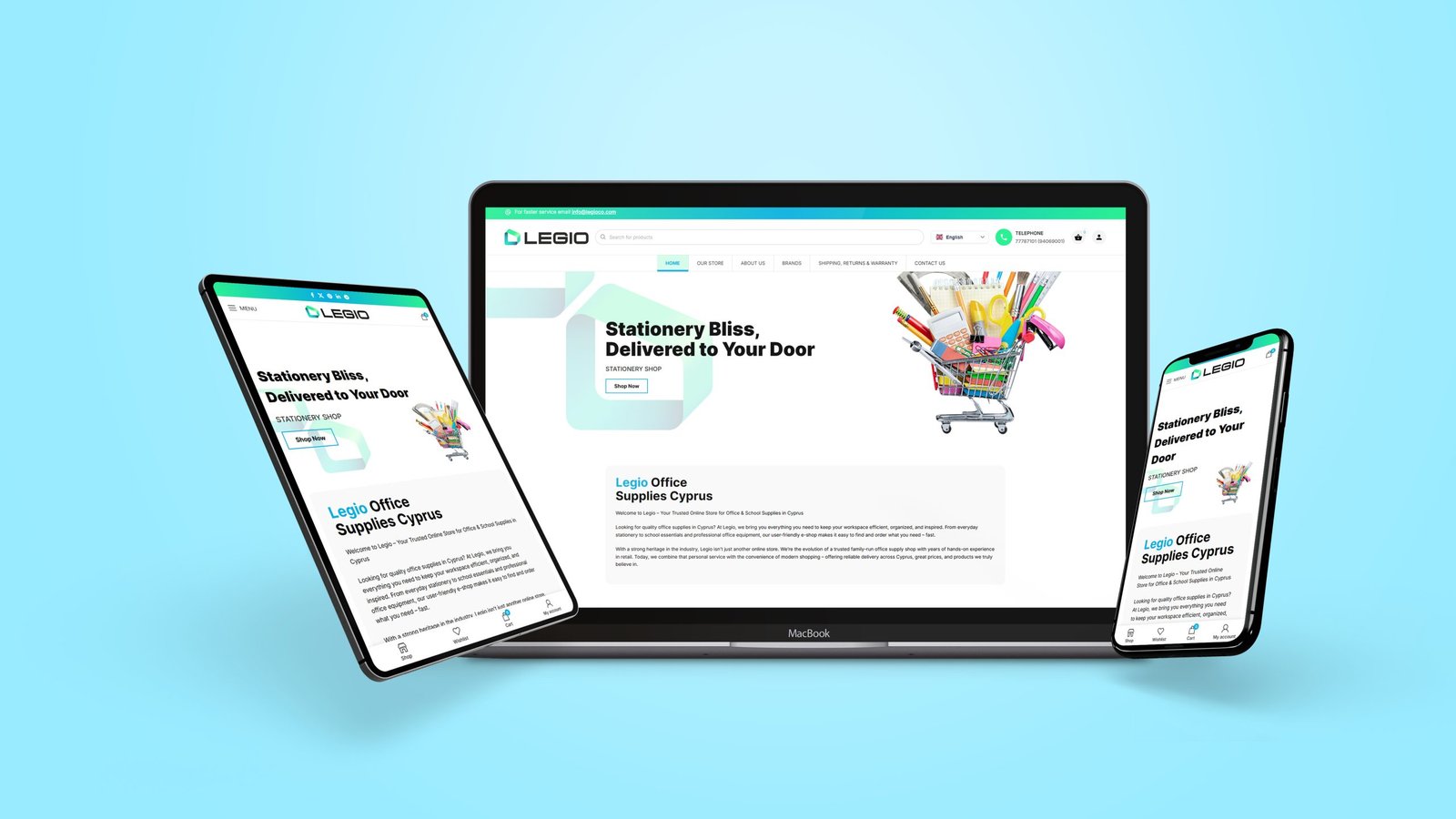
The Figma design was converted to WordPress using Elementor for the homepage sections — the Slider Revolution-powered hero with the primary store CTA, the category strip, the featured products grid, and the newsletter signup — while WooCommerce’s built-in templates handled the shop archive, individual product pages, cart, and checkout flow. Custom CSS was applied throughout to bridge the Figma design’s typographic choices, spacing, and button styling with the WooCommerce and Elementor default rendering, ensuring visual consistency from the homepage through to the account and order confirmation pages.
The dual-logo system — a color version for the standard header and a white version in the footer — was configured through WordPress’s standard theme logo controls, with the footer variant delivered via custom CSS targeting the footer logo container directly rather than adding a secondary logo upload field.
Technical Implementation
The most technically significant element of the build was the custom Pay Later plugin, developed specifically for Legio’s B2B account management model. The plugin introduces a Pay Later payment method in WooCommerce checkout, visible exclusively to logged-in registered users rather than guest visitors or retail accounts. Each registered business user account can be assigned a configurable credit limit through the WordPress admin, set individually to reflect the credit terms agreed between Legio and that account. When a logged-in business user reaches checkout, the Pay Later option displays their available credit balance, and the plugin validates that the order total does not exceed the remaining credit before allowing the order to proceed. Completed Pay Later orders are tracked against the account’s running credit balance, which reduces with each approved order and can be reset or adjusted by the admin when a payment cycle is settled.
Zoho CRM integration was configured to sync new customer registrations, order data, and account status to Legio’s existing Zoho environment automatically, eliminating manual data entry between the WooCommerce store and the sales and account management workflows the business already operated in Zoho. Email integration was set up through SMTP configuration, ensuring transactional emails — order confirmations, shipping notifications, Pay Later order approvals, and account registration emails — deliver reliably rather than routing through WordPress’s default PHP mail function, which carries significant deliverability risk for a store handling business-critical order communications.
Payment gateway setup was completed for standard retail checkout, supporting Cyprus-issued card transactions and displaying accepted payment methods visibly in the checkout and footer to address the trust signals important to first-time online buyers transitioning from an in-store purchasing relationship.
User Experience Improvements
The Pay Later checkout flow was designed to feel transparent and low-friction for business users. The available credit balance is displayed at checkout before the user commits to the order, and a clear message handles the edge case where an order would exceed the remaining credit limit — preventing confusion or failed orders without requiring customer service intervention. For retail users, the standard WooCommerce checkout remains unchanged, keeping the purchase experience straightforward for non-account buyers. The wishlist functionality allows both buyer types to save and return to specific products, which is particularly useful for business procurement officers building a repeat order list.
Performance Optimization
The Slider Revolution hero was configured with lazy loading for below-fold slider assets, preventing the full slider asset bundle from blocking the initial page paint. Product images across the catalog were served at display-appropriate dimensions rather than full-resolution uploads, reducing page weight on the shop archive and category pages where many product images render simultaneously in a grid layout. Elementor’s external CSS print method was enabled to keep homepage styles off the critical render path.
Mobile Optimization
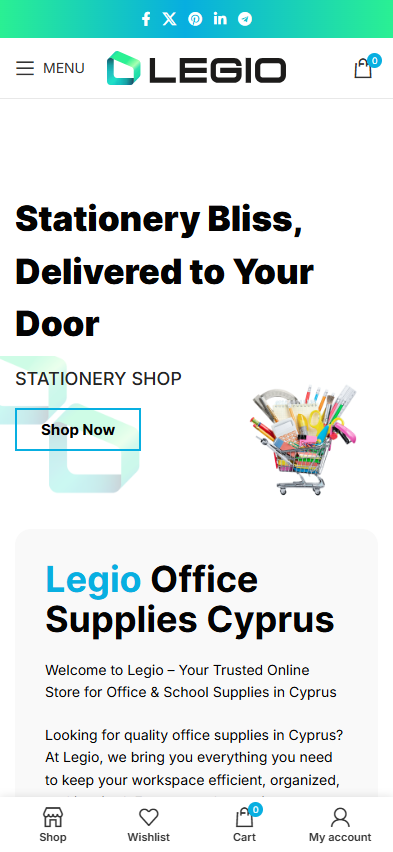
The horizontal category strip on the homepage was converted to a horizontally scrollable row at mobile widths rather than a two-row grid, keeping all category options accessible in a single swipe gesture without expanding the vertical space they occupy. The WooCommerce product grid reconfigures from a multi-column desktop layout to a two-column mobile layout, maintaining product card readability and the Add to Cart button size at touch-friendly dimensions. The Pay Later checkout option was tested across mobile viewport sizes to confirm the credit balance display and order validation messaging remain legible and functional on smaller screens.
Conversion Optimization
The Pay Later capability is itself a conversion mechanism for the business’s most valuable customer segment — B2B account holders who would otherwise require a manual invoicing process for each order. Making credit purchasing available directly through the WooCommerce checkout removes the friction that previously required phone or email-based order placement for credit account customers, increasing order frequency and reducing the administration overhead on both sides. The newsletter signup section captures email addresses from visitors not yet ready to purchase, building a list for promotional communications managed through the integrated email system. Zoho CRM data enables the sales team to identify high-value accounts, follow up on inactive customers, and track order patterns across the business account base without manual reporting.
Final Outcome
The completed store gives Legio Office Supplies a fully operational ecommerce platform capable of serving both retail buyers and business account holders through a single WooCommerce installation. The custom Pay Later plugin replicates the credit account model the business has historically operated in a retail context, while the Zoho CRM integration, SMTP email setup, and payment gateway configuration give the business the operational infrastructure needed to manage a growing online customer base efficiently.
Conclusion
This WooCommerce store development project for Legio Office Supplies demonstrates how a well-scoped custom plugin can extend WooCommerce into genuine B2B territory, handling per-user credit limits and Pay Later checkout in a way that matches established trade account relationships without requiring a separate B2B platform. Combined with Zoho CRM integration, reliable email delivery, and a clean Figma-to-WordPress conversion, the build gives a heritage office supply business the ecommerce infrastructure to serve both its existing account base and new retail customers from a single, manageable store.